News5 min read
Education Minister says improved CXC results will be followed by long-term reforms
Minister of Education, Sonia Parag (Elton John photo)
Published by Randy Daniels
Minister of Education, Sonia Parag (Elton John photo)
— Parag moves to strengthen secondary education with new task force
MINISTER of Education, Sonia Parag, has noted that Guyana has recorded improvements in various areas, as evidenced by this year’s preliminary Caribbean Examinations Council (CXC) results, with several Government interventions beginning to bear fruit.
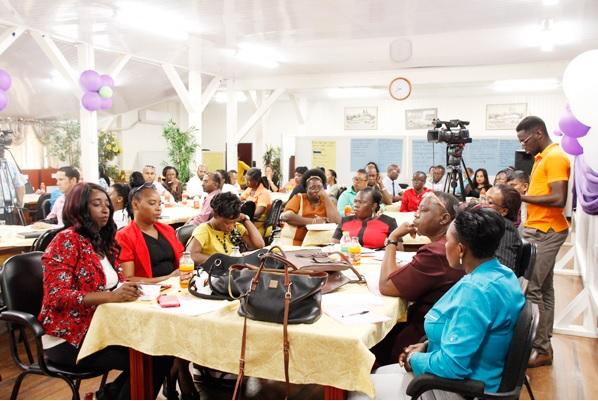
The Minister made this known while delivering the feature address at the results ceremony, held at the Guyana Marriott Hotel, where she announced plans to convene a task force to examine long-term measures to further strengthen secondary education.
Parag noted that while the improved performances at the Caribbean Secondary Education Certificate (CSEC) and Caribbean Advanced Proficiency Examination (CAPE) levels were cause for celebration, the Government’s ambition extends beyond short-term improvements.
“I am particularly pleased with the improvements we have seen this year in both mathematics and additional mathematics because they tell us that the interventions we have been making are beginning to bear fruit,” the Minister said.
She pointed to several initiatives implemented to address mathematics performance, including the establishment of mathematics tents, strengthened teacher training, online reinforcement classes and other targeted support.
Parag also highlighted a more recent intervention through which education officers were deployed to schools to work directly with teachers and students, particularly in mathematics.
She said the officers spent periods working with schools to help improve performance, while thanking those who participated in the initiative.
The Minister said the improvements in mathematics were particularly significant given that the subject was also a major area of discussion at last week’s 52nd meeting of the Council for Human and Social Development in Education, hosted in Guyana.
According to Parag, education ministers and officials from across the Caribbean recognised that mathematics remains a regional challenge, requiring changes in teaching approaches, stronger support and continuous professional development for teachers, as well as greater use of diverse methods to help students understand mathematical concepts.
Further to this, the Minister indicated that digital and artificial intelligence-supported tools could also be responsibly incorporated into learning, but noted that students must understand the reasoning and process behind an answer rather than simply arrive at the correct response.
Meanwhile, she highlighted Guyana’s performance in the Caribbean Certificate of Secondary Level Competence (CCSLC), particularly at St George’s School of the Sciences, which recorded a 99.1 per cent mastery rate in its first year of participation in Guyana’s public school system.
She said the CCSLC was introduced to strengthen the critical period between the National Grade Six Assessment and CSEC by ensuring that students continue developing and mastering competencies as they progress through secondary school.
Additionally, the Minister used the occasion to challenge the perception that academic excellence is concentrated within a small group of traditionally high-performing schools.
She pointed to the achievements of public schools across the country, including schools in hinterland, rural and other regions, which recorded 100 per cent passes in individual CSEC subjects.
Among those highlighted were schools recording 100 per cent passes in Agricultural Science, Biology, Chemistry, American History, Electronic Document Preparation and Management, English A, English B, and Human and Social Biology.
Parag further recognised schools that recorded overall CSEC pass rates above 80 per cent, highlighting the performances of Queen’s College, with 97.1 per cent; Bishops’ High School, with 96.1 per cent; and President’s College, with 93.9 per cent.
She noted that these performances represented the strongest results recorded by the respective schools since the pandemic year of 2020.
President’s College, she said, improved significantly from an 87.7 per cent pass rate in 2025 to almost 94 per cent this year, while St Stanislaus College recorded 94.2 per cent, its strongest performance since 2022.
St Rose’s High School also recorded its strongest performance since 2023.
She further highlighted Leguan Secondary, which achieved an 89.9 per cent overall pass rate, describing it as the school’s strongest performance in recent history.
She gave particular recognition to Belladrum Secondary School, which recorded a 93.4 per cent overall pass rate after generally remaining within the 40–50 per cent range over the past six years.
The school also recorded 100 per cent passes in several subjects.
“Excellence is happening across schools in Guyana,” Parag affirmed.
She went on to note that the results demonstrate that outstanding performance is not determined by a school’s name or location.
As such, she urged parents to reconsider negative perceptions of schools, particularly during the next secondary school placement period, and warned against diminishing schools, teachers or students in the pursuit of what parents consider the “best” school.
Against this backdrop, Parag announced the planned task force, saying the education system cannot be built around short-term interventions alone.
“I believe strongly that we cannot build an education system around short-term interventions alone,” she said.
“They have their place, and they are sometimes necessary. But the changes we make must be strong enough to endure beyond one cohort of students.”
She said the task force will examine the long-term measures needed to further strengthen secondary education.
“Our ambition cannot simply be to say that the results have improved. They have, and we are grateful. They have, and we are pleased about that. Our ambition must be to take the performance to the standard we know our students are capable of achieving,” Parag said.
She also pointed to the Guyana Digital School, which from August 31 will provide curriculum-aligned content for students from Grades One through 11, including secondary-level material aligned with CXC syllabuses.
Parag said the platform will provide another layer of support for students, allowing them to reinforce classroom learning, access lessons outside school hours, and assist students in remote areas or families unable to afford private lessons.
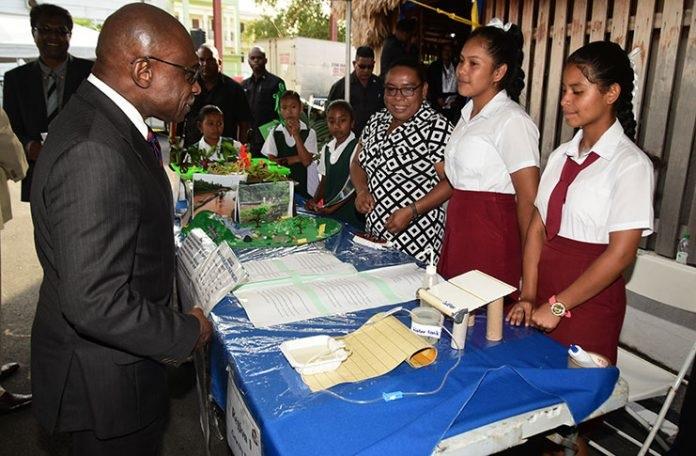
Further to this, she linked the results to the Government’s wider push for technical and vocational education and training, noting the practical products being developed by students and the involvement of secondary school students in catering for Caribbean education ministers during last week’s regional meeting.
She said these initiatives are intended to equip young people with the competence, confidence and practical skills required to participate in Guyana’s rapidly changing economy.
Meanwhile, Parag urged students to remain committed to learning regardless of their results, reminding those who were disappointed that an examination result should not define their potential.
Share this post