News3 min read
MOUs Signed for International Education and Energy Skills
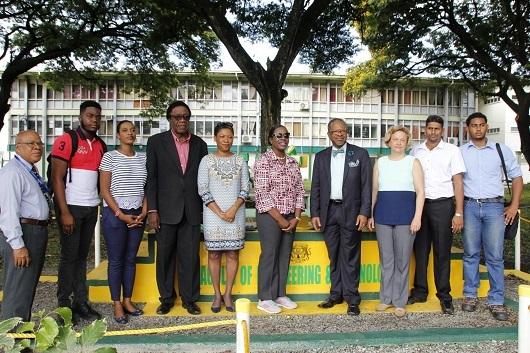
Memoranda of Understanding (MOUs) to strengthen International Collaboration signed between Ministry of Education and Red Deer College and National Energy Skills Centre.
Published by Randy Daniels
Memoranda of Understanding (MOUs) to strengthen International Collaboration signed between Ministry of Education and Red Deer College and National Energy Skills Centre.
In a significant stride towards enhancing global partnerships and fostering knowledge exchange, three Memoranda of Understanding (MOUs) have been established between the Office of the Deputy Chief Education Officer for Technical Vocational Education and Training (DCEO-T/MOE) and notable educational institutions abroad. These MOUs signify a commitment to collaboration and the sharing of vital information aimed at advancing educational opportunities and practices.
Partnership with Red Deer College, Canada: The first MOU establishes a partnership between the DCEO-T/MOE and Red Deer College in Canada. This collaboration aims to leverage the strengths of both institutions in the field of technical vocational education. Red Deer College, known for its innovative programs and expertise in vocational training, will collaborate closely with the DCEO-T/MOE to exchange best practices, curriculum development strategies, and faculty development initiatives. This partnership not only enriches educational offerings but also opens avenues for international learning experiences for students and faculty alike.
Collaboration with National Energy Skills Center (NESC), Trinidad & Tobago:
The second MOU is forged between the DCEO-T/MOE and the National Energy Skills Center (NESC) in Trinidad & Tobago. NESC is renowned for its specialized training programs in energy-related fields, aligning closely with the technical vocational education priorities of the DCEO-T/MOE. Through this partnership, both institutions will collaborate on curriculum enhancement, joint research initiatives, and student exchange programs. The sharing of information and resources will contribute to the development of skilled professionals in critical sectors, meeting the evolving demands of Trinidad & Tobago’s economy.
Partnership with Linden Technical Institute (LTI), Government Technical Institute (GTI), and New Amsterdam Technical Institute (NATI): Additionally, the MOU extends to include Linden Technical Institute (LTI), Government Technical Institute (GTI), and New Amsterdam Technical Institute (NATI) within the national framework outlined by the Ministry of Education. This partnership focuses on faculty training and development, curriculum development, and national manpower development. By aligning with the national agenda for Technical Vocational Education and Training (TVET), these collaborations aim to bolster institutional capacities and enhance educational offerings in technical fields.
The objectives and benefits of the MOUs are as follows:
Objectives of the MOUs:
Enhanced Collaboration: Facilitate joint projects, research, and curriculum development initiatives. Knowledge Exchange: Share expertise, best practices, and educational resources. Student and Faculty Mobility: Promote international mobility for students and faculty through exchange programs and collaborative projects. Capacity Building: Strengthen institutional capacities through training and professional development opportunities.
Benefits: Global Perspective: Expose students and faculty to international educational practices and perspectives. Skills Development: Enhance the skills and competencies of students in technical and vocational fields. Innovation: Foster innovation in curriculum design and educational methodologies. Long-term Partnerships: Build sustainable partnerships for continuous improvement and mutual benefit.
These MOUs represent a significant milestone in fostering global partnerships and enhancing educational excellence in technical vocational education. By joining forces with Red Deer College in Canada, NESC in Trinidad & Tobago, as well as LTI, GTI, and NATI locally, the DCEO-T/MOE aims to create a collaborative framework that will contribute to the advancement of education and workforce development both domestically and internationally. Through shared expertise and resources, these partnerships are poised to make a meaningful impact on the educational landscape, preparing students for success in an increasingly interconnected world.
Share this post