News5 min read
School safety and belonging are at the heart of Guyana’s new Community of Practice
The launch of a Community of Practice in Guyana marks a new step in strengthening instructional leadership in districts and schools nationwide.
Published by Randy Daniels
The launch of a Community of Practice in Guyana marks a new step in strengthening instructional leadership in districts and schools nationwide.
Stephanie Bengtsson / IIEP-UNESCO
All rights reserved
Across Guyana, a crucial question is preoccupying education leaders, teachers and communities. What can help make a school feel safe?
For a student, it can mean knowing that an adult will listen without judgement. For a parent, it can mean being confident that the school will communicate openly and respond when something goes wrong. For a teacher, school or district leader, it can mean fostering a school environment where every student feels respected and supported in their learning journey.
Recognizing this challenge, the Ministry of Education made this the theme of the 14 September launch of the Educational Leadership Community, a new Community of Practice (CoP) that expands the reach of Guyana’s National Education Leadership Academy (NELA) by creating a permanent online space for education leaders, teachers, parents, and the wider education community to exchange and learn from each other.
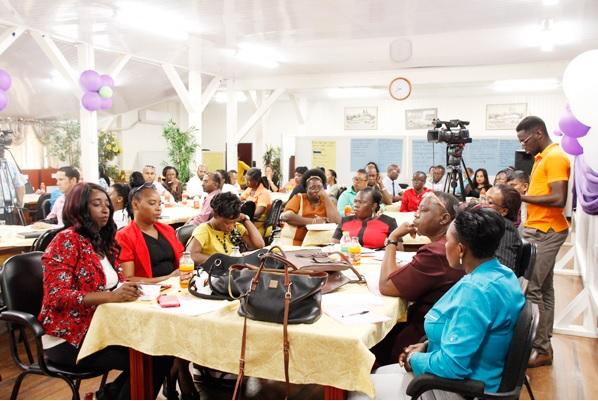
Held virtually under the theme Leadership that Cares: Safer, More Inclusive Schools in Guyana, the launch brought together more than 240 participants from schools, parent representatives, education offices, and partner institutions.
Led by Guyana’s Ministry of Education, the CoP is supported by the Global Partnership for Education (GPE) and the Inter-American Development Bank (IDB), with the UNESCO International Institute for Educational Planning (IIEP-UNESCO) as lead technical partner.
“Caring for the safety and belonging of students is part of every leader’s work. The direction is set here, in Guyana, and our partners help us go further.”
Mischka White-Griffith,
Parliamentary Secretary and Chief Planning Officer, Ministry of Education, Guyana.
A focus on school safety and belonging
Alongside international evidence and expertise, the launch included those who witness the realities of school safety and belonging.
For La Shanna Anderson, Regional Education Officer for Guyana’s Region 10, safer schools are built by stronger relationships and not rules alone. A sense of belonging starts when a child can say: "I am safe here, I am respected here, I am supported here".
Joel Mcphoy, Senior Master at Queen’s College, described what that looks like from the front of a classroom, where a teacher remains approachable and does not immediately judge or shame a student who comes forward.
Nadia Hollingsworth, National Parent-Teacher Association (PTA) Coordinator, argued that trust between schools and families depends on clear, timely communication.
Abhivir Singh, Student Council President at Queen’s College, pushed this idea further. "Mutual respect is not built on token seats at the table. It is grown where leaders trust students' input as an indispensable driving force in school governance."
Education specialists brought international evidence into that same conversation. Xavier Hospital, Team Leader for Safe and Healthy Schools and Data at UNESCO, presented a whole-school model spanning curriculum, school climate, reporting, policy, partnership, and data.
IIEP-UNESCO
“To effectively prevent violence and respond to violence, there is a need for a whole-school approach. It is not enough to have teachers address the topic or to have a policy about it. We must act at several levels.”
Xavier Hospital, Team Leader,
Safe and Healthy Schools and Data, UNESCO.
María Fernanda Prada Patiño, Senior Education Specialist at the IDB, also shared programmes shown to substantially curb school violence when carefully adapted to context, including one that "reduced teacher-to-student physical violence in less than eight months by 42 percent," while stressing that no programme works as a template lifted wholesale into a new setting.
Expanding beyond NELA
Guyana’s NELA flagship training programme is investing in a new generation of education leaders. Its first cohort of 100 education leaders began training in December 2025 and will continue through July 2027, combining structured coursework with applied leadership projects. A second cohort is also being recruited.
The Guyana CoP builds on this foundation, creating a space where the learning, evidence, and leadership practices developed through NELA can continue to be shared, explored, and put into practice across the wider education system.
Open to school and district leaders, teachers, Ministry staff, parents, and other members of the education community, the CoP will connect people working at different levels of the system. Through ongoing exchange, participants can share experiences, engage with new evidence, and learn from one another as they work to strengthen school and district leadership.
“Effective implementation requires the ability to learn, use evidence, listen, adjust, and sustain action over time. The Community of Practice that we are now launching translates those principles into collective action.”
Martín Benavides, Director, IIEP-UNESCO.
National ownership through partnership
The launch also underscored an important principle: Guyana's broader education reform must remain nationally led, with development partners playing a supporting role.
Lorena Solórzano Salazar, IDB Country Representative for Guyana, said the vision, leadership, and direction of Guyana’s efforts to strengthen educational leadership "remain Guyana’s own," with development partners there "to support the national efforts, share knowledge, strengthen capacities, and accompany the journey towards long-term results".
Ciara Cristina Rivera Vazquez, GPE Country Program Officer, framed the CoP as a space to help ensure that the reform reaches every classroom: "We will know if the reform is working when your leadership and your capacity are embedded across the system."
“Leadership that cares is leadership that acts. Care must be translated into responsible action.”
Mark Anthony Lyte,
NELA Course Instructor, Guyana.
A new, inspiring model
Guyana is among the first countries to pair a national leadership academy with a peer network from the outset. IIEP, which has supported the Ministry throughout the design of both NELA and the CoP, is following the experience closely as it works with other ministries seeking to extend leadership reforms beyond a single training cohort and expects Guyana’s approach to inform that work elsewhere.
Ministry of Education, Guyana
“School leaders understand the daily realities of students, teachers, and families. District and regional education offices connect experiences across schools and mobilize wider support. Communities, families, and students themselves provide essential perspectives on how policies and leadership are experienced in practice.”
Candy Lugaz, Programme Specialist, IIEP-UNESCO.
Share this post